



Quick, Playful Writing Exercises for When You’re Feeling Stuck
electricliterature.com – Tuesday April 14, 2026
A student recently asked, looking at the bookshelf in my office, “How did all these people get from here to there? From words on a screen to bound on the shelf?” I started to give her practical advice about staying in the chair and reading the right novels, but that is only a small part of how a piece of art grows up.
We are not ever just writers—we are also sons and daughters of good parents and disappointing parents and we are partners who need to grab a quart of milk on the way home and parents who crawl into bed with the little ones late at night to admire them when they are still, even though we know we don’t have any tiredness to spare. We are students and teachers. We are readers, taking in the universes created by other minds. Our stories and poems and essays are written in and among and because of these moments. A scene is not only a moment on the page that takes place in space and time—the writing of that scene takes place in space and time too. I remember working on an especially dark section of my first novel, No One Is Here Except All of Us, in which the character based on my great-grandmother escapes pogroms by fleeing with her children into the Russian wilderness where she survives on tree bark, and it so happened that this writing day took place beside a swimming pool at a Southern California hotel where my father-in-law was staying while he visited us. I spent the morning in the shade surrounded by Disneyland-bound families and I wrote about starvation. You can’t see that in the pages, but the energy of that good, easy day provided an opposite to the story from the past and its fictional counterpart. That strange pairing was part of how I powered the writing.
We do not write outside of our lives or in spite of them, but because of them. Writers make a choice to carve out significant time—some squeeze writing in while a baby sleeps on their chest or during the lunch hour. Some dictate a story while driving to work. The walls of stuck-ness are easily built. Time is always short; fear is a capable bricklayer; self-doubt and envy can construct a windowless room in seconds. While I love encouragement and good cheer (can you see me waving my pom-poms? I am!), those are not enough to free us. What I believe in, what has worked for me over and over, is a repertoire of small, playful, and unintimidating experiments. Lots of them. A small choice is huge. So often you need a little light, some air, and a handle turns in your hand, you peek through to the next thing, and you’re back, you’re in, you’re running.

Too hot to handle? Why it’s time for straight male authors to rediscover sex
theguardian.com – Sunday April 12, 2026
It’s a high-wire act and the risk of an embarrassing failure can weigh heavily – but that’s no reason to avoid writing about sex, argues Black Bag author Luke Kennard
Are straight male writers scared of writing about sex? If you read modern fiction it’s hard to conclude otherwise. Maybe we’re worried that the very presence of a sex scene in our book would feel somehow exploitative or gratuitous. Or maybe we feel our gender has simply said enough on the subject so we should shut up.
Women writing about straight relationships don’t seem as nervous. In fact, sex is often a central element of narrative, and of nuanced portrayals of masculinity; from the slow-burn tenderness and awkwardness of intimacy in Sally Rooney’s work, to the surreal celebrations of and lamentations for the erotic in Diane Williams’s extraordinary short stories.
The Bad Sex in Fiction award wrapped up in 2019. It is not missed – for me, its offence was that it conflated comically bad writing about sex with great writing about sex that happened to be bad. Still, the funniest and most excruciating winners were straight men trying and failing to write sincerely and exuberantly about sex, and landing somewhere between the ludicrously metaphorical and the shoddily pornographic or exoticising. Past winners have included James Frey (“Blinding breathless shaking overwhelming exploding white God I cum inside her …”) and Didier Decoin (“Katsuro moaned as a bulge formed beneath the material of his kimono …”).

Indie authors are redefining the publishing world
dailyuw.com – Saturday April 11, 2026
Throughout writing this series, I’ve realized that one of the biggest myths about the publishing industry is that there is a single “right” way to publish a book. As nice as that idea may be, there is no golden standard or easy-to-follow tutorial. Every author needs to choose the path best for them.
One of the most important decisions an author must make is whether or not they choose to traditionally publish their book with the help of a publishing house or to self-publish it.
In recent years, self-publishing (also known as independent or indie publishing) has grown exponentially. According to Bowker, the official ISBN agency for the United States, over 3.5 million books were self-published last year, a 38.7% increase from 2025. In comparison, only 640k books were traditionally published in 2025.

Question and Agent: Amanda Orozco of Transatlantic Agency
debutiful.net – Tuesday April 7, 2026
Welcome to Debutiful’s Agent Week! We gathered some of our favorite literary agents representing the most exciting debut books and asked them questions about what makes them love a submission, their agenting style, and the books they’re working on.
Amanda Orozco has been a literary agent at Transatlantic Agency since 2020, where she is drawn to stories from Asian and Latinx writers. Her clients include Shoshana von Blanckensee, m. mick powell, and Nick Medina. She seeks work where protagonists have a distinct voice and personality, where the plot is clever, quirky, gritty, or twisty.
We dug into why writers should know everything in publishing takes more time than they’d expect, representing both fiction and nonfiction, and her opinion on genre with a capital G.

Question & Agent: Stephanie Delman of Trellis Literary Management
debutiful.net – Monday April 6, 2026
Welcome to Debutiful’s Agent Week! We gathered up some of our favorite literary agents representing the most exciting debut books and asked them some questions about what makes them love a submission, their agenting style, and what books they’re working on.
Stephanie Delman spent 10 years at Sanford J. Greenburger Associates before starting Trellis Literary Management with Michelle Brower and Allison Hunter. Her client list includes countless Debutiful favorites, including Vanessa Chan, Eshani Surya, Jenny Tinghui Zhang, and Gina María Balibrera.
We dug into what makes her a “hands-on” agent, why starting Trellis was the best decision in her life, and what makes her excited for a submission.
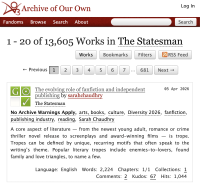
The evolving role of fan fiction and independent publishing
sbstatesman.com – Monday April 6, 2026
A core aspect of literature — from the newest young adult, romance or crime thriller novel release to screenplays and award-winning films — is trope. Tropes can be defined by unique, recurring motifs that often speak to the writing’s theme. Popular literary tropes include enemies-to-lovers, found family and love triangles, to name a few.
A place where tropes have always thrived are fan fiction platforms, particularly Wattpad and Archive of Our Own. In the past decade alone, the number of fan fiction uploads and fan fiction engagement has increased exponentially. In 2014, AO3 hit one million published works. In 2018, the platform was home to over four million works. As of early 2026, the site reports hosting over 17 million fanfics.
However, for active engagers in fan fiction communities, it’s undeniable that these fandoms feel less active than they did five years ago. This can be attributed to a wide range of reasons — fandom engagement, the rise of “niche” communities and a new approach to appreciating fan fiction stories — particularly the tendency to hyperfocus on tropes.
New readers make a habit of moving quickly from piece to piece, consuming only to leave “kudos,” the AO3 equivalent of likes, while barely leaving comments or actually reading the entire story.
As popular as this community is, especially in the digital age, fan fiction is seldom spoken about in literary circles. Some claim systemic propagation plays a role in this. Fan fiction is often associated with secrecy as it lends itself to mockery, especially since it is a female-dominated medium.

I wrote a novel using AI. Writers must accept artificial intelligence – but we are as valuable as ever
theguardian.com – Thursday April 2, 2026
I recently heard an exchange at a playground that should worry the executives at AI companies more than any analyst’s prediction of a bubble. A boy and a girl, maybe 10 years old, were fighting. “That’s AI! That’s AI!” the girl was shouting. What she meant was that the boy was indulging a new and particular breed of nonsense: language that sounds meaningful but has no connection to reality. The children have figured the new world out quickly, as they do.
Artificial intelligence is here to stay, neither as an apocalypse nor as the solution to all life’s problems, but as a disruptive tool. The recent scandal over Shy Girl, the novel by Mia Ballard, was doubly revealing. Hachette cancelled its publication amid claims it was reliant on AI generation (Ballard has said that an acquaintance who edited the self-published version used AI, not her). But the book was originally self-published. Apparently readers and editors didn’t mind until the use of AI was pointed out to them.
The fact that machines can generate meaning in the first place is an existential curiosity. But for writers, and for young writers in particular, AI has a more practical significance. A recent survey found that 86% of college students use AI regularly, which means that 14% are lying to survey-takers. The ordinary business of quotidian language – writing student essays, emails, memos, all the granular sentence-by-sentence work that once trained writers in their craft – is dissolving. Mastery of style, the laborious gift of the skilled writer, is being automated.

‘Soon publishers won’t stand a chance’: literary world in struggle to detect AI-written books
theguardian.com – Sunday March 29, 2026
US release of horror novel Shy Girl cancelled and UK book discontinued after suspected AI use, as publishers feel ‘cold shiver’
Recently, the literary agent Kate Nash started noticing that the submission letters she was receiving from authors were becoming more thorough – albeit also more formulaic.
“I took it as a rise in diligence,” she said. “I thought it was a good thing.”
But then she had what she described as her eureka moment: the letter with the AI prompt right at the top. “It read: ‘Rewrite my query letter for Kate Nash including a comp to a writer she represents,’” she said.
Once Nash had seen the prompt, she “couldn’t unsee AI-assisted or AI-written queries again”.
A Guide for Aspiring Authors
universityobserver.ie – Tuesday March 24, 2026
In order to be a writer, one must form a writing habit. Pick a dedicated time in your schedule where you write. It does not matter how long you write for or what time you select. The key is consistency. Building this habit requires you to take yourself, and your writing seriously.
I recently attended an event at Chapter’s Bookstore, hosted by the Romantic Novels Association, a professional body dedicated to raising the prestige of romantic fiction. At the event, the association’s chair and director, Seána Talbot, spoke about the importance of respecting your desire to write as much as your other commitments.
For students, this might look like setting deadlines for your writing goals just as you would with your assignments, or informing your roommates that you need some quiet time in the same way you do when you study.
Build a community:
It can be much easier to motivate yourself to do something when you belong to a group with the same interests or goals. If you are not in a literature or creative writing degree, this can be harder to find as a student. That said writing groups you can join as a student still exist.
UCD Lit Soc hosts regular writing sessions where students from all courses can come together to write and share their work with others. Volunteering with organisations such as Fighting Words also gives access to events with other writing and literature enthusiasts. This is a great way to meet people with the same interests and sometimes network with others from the industry.

Can anyone get a book deal? What it takes to be a novelist in 2026
eu.usatoday.com – Sunday March 22, 2026
Consolidation, fewer imprints and editorial bottlenecks are reshaping how fiction book deals are acquired and developed in today’s publishing market.
“From Pitch to Publication” is a series taking readers behind the curtain of modern publishing as a business.
I’m so accustomed to rejection that I brace myself for every email – even before opening. Even when good news may be waiting after that click.
Writers, and all creatives to an extent, have to get accustomed to “no.”
About 81% of Americans feel that they have a book in them, according to an often cited survey reported in The New York Times (from the early 2000s). Many aspire to write and publish a book in their lifetime, but only a small fraction see their work formally acquired and announced each year. A little over 2,000 fiction writers announced deals in 2025 on Publishers Marketplace.
What's it like to write a bestseller? We followed Lucy Score for a year to find out
This year, one of those deals announced is mine: My debut young adult novel, “How to Kill a Chupacabras," was acquired by independent publisher Tiny Ghost Press. I almost dismissed the email confirming the offer as another rejection.
Get the free newsletter | Submit a news item or article | Get Writers' News for your website