

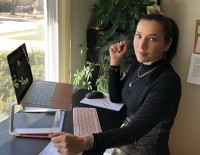
Melissa Febos on Her Literary Inspirations, Writing Habits, and Notebook Fetish
interviewmagazine.com – Wednesday March 31, 2021
This is First Draft, in which our favorite writers get to the bottom of their own craft. From preferred writing drinks to whether or not you really need to carry a notebook, we find out all the ways they beat writer’s block and do the work. Before curling up with Girlhood, Melissa Febos’s new collection of personal essays, discover all the elements that helped her get it done.
Finding Ideas To Write About
By Marcella Simmons
Freelance Writer
firstwriter.com – Monday March 29, 2021
Ideas are everywhere. They are in your home, your car, at your work - you can find ideas at the park, the grocery store, the doctor's office, at school or in your bed. Ideas happen everyday, non-stop and you can use them in both fiction and nonfiction as well as poetry. Look around you.

Let’s Get Lit-erary: How an idea turns into a book
dailycampus.com – Wednesday March 24, 2021
So you have an idea, but how exactly do you turn it into a fully-fledged novel? What does it take to see your idea unfold and make its way to a bookstore? The process can be long and grueling, but certainly worth the investments of time and money. The road to publishing is easier for established authors, but, of course, they too were once rookies. So here’s a guide to getting your book written and published, from someone who has yet to do either of these things, but spends her free time aspiring to be a novelist.
The first step is to write a manuscript — essentially a polished draft. Now, this is easier said than done. Different writers have different approaches to tackling a manuscript. Some are plotters, others consider themselves pantsers. A plotter goes through the different acts of their story before even delving into writing it. Developing a clear outline guides plotters as they type their tale, preventing it from straying off track and minimizing revision time. Pantsers, on the other hand, prefer to let ideas come to them as they write, allowing more freedom than an outline might provide. Other writers do a mixture of both, creating general guidelines beforehand, but diverging as they feel fit.

YOUTH: THE WRITING CONTEST
dawn.com – Sunday March 21, 2021
Gen Z and millennials are known as the generation of hustlers. We crave the notion of consistent productivity. We respond to texts and non-urgent emails within the hour, as we continuously update our followers on social media platforms about the minutiae of our existence, all the while feigning the image of #livingourbestlives.
Generally, it’s a struggle for us to slow down. In fact, we don’t really know how to. It is our naive belief that a culture of workaholism will somehow translate into a happier life. Even as we find ourselves in the midst of a global pandemic, the same rules apply.
I’ve been a freelance journalist, writer and poet for almost three years. Writing was initially a creative outlet for me, a way to digest all my thoughts about the noise of the world into a well-structured article. Slowly, my writing acquired a sizable readership and soon I was writing for noteworthy publications. However, over time I noticed that, once purely an exciting endeavour, writing assignments now only brought on a wave of anxiety.
How to decide when to ‘rescue’ your darlings and other writing tips
poynter.org – Saturday March 20, 2021
Although I have been unable to teach in-person writing workshops during the pandemic, my Zoom teachings have been zooming. Almost all of these virtual workshops have been pro-bono, but I have received rewards beyond money. A favorite activity is “visiting” a writing class, especially one that is using one of my writing books as a text. I have fun, play a little music, and get treated like Obama or Springsteen.
In other years, I would have walked across the street from the Poynter Institute to visit a class at the St. Petersburg campus of the University of South Florida. Instead, I taught this week, in my new mode, from a computer perched on our dining room table.
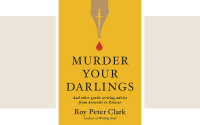
The day before the class, the teacher, veteran journalist Janet Keeler, submitted a list of questions from the students who had been studying my most recent book “Murder Your Darlings: And Other Gentle Writing Advice from Aristotle to Zinsser.” In short, it’s a writing book about writing books.
The questions were so good, I was inspired to sit down for an hour or so and answer them in writing. Those questions and answers, lightly edited for clarity, may be of use to you in your own work. I hope so.
Know thy reader
thebookseller.com – Friday March 12, 2021
With the levelling off of e-book sales, many have begun to wonder whether the book publishing industry will be spared the kinds of disruption experienced by other sectors of the media industries. But the digital transformation of the book publishing industry was never fundamentally about e-books anyway: e-books turned out to be just another format by which publishers could deliver their content to readers, not the game-changer that many thought (or feared) it would be. The big question that the digital revolution posed to book publishers is just as pressing today as it was a decade ago: it’s the question of how publishers understand who their ‘customers’ are, and how they relate to and interact with them.
For most of the 500-year history of the book publishing industry, publishers understood their customers to be retailers: publishers were a B2B business, selling books to retailers, and they knew very little about the ultimate customers of their books, the readers. The digital revolution has forced publishers to think again about this model and to consider whether there might be something to be gained by becoming more reader-centric. This fundamental shift in publishers’ self-understanding is likely to be one of the most significant and enduring consequences of the digital revolution in publishing.
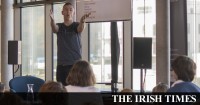
How do writers of children’s books meet their readers during a pandemic?
irishtimes.com – Tuesday March 9, 2021
On March 12th last year I was sitting in a blustery, empty car park in Blackpool, Lancashire, eating a bland prepacked sandwich beside a giant mural of Barry from The Chuckle Brothers. I was feeling pretty good about myself.
Sure, school closures had just been announced and the St Patrick’s Festival (at which I had an author event) had been cancelled, but I’d just finished a school talk about my children’s books. It had been the last of a four-day book tour of England and my 39th author event in 40 days.
Irish events included every Dublin city library, several bookshops, a delightfully raucous event with illustrator Ben Mantle at Liberty Hall Theatre, a school in the Dublin Mountains, classes of kids spread out on the floor of O’Mahony’s Booksellers in Limerick, a packed-out art workshop in the Hugh Lane Gallery, a lot of M50 miles, a couple of flights, and a handful of hotel breakfast buffets I now regret not taking full advantage of.
It had been exceptionally busy, but still just about within the range of expectations when you write books for children. I had done hundreds of events over the preceding years, to audiences as high as 700 and as low as one (there had been a mix-up, I was assured). This is the life of writers for every age and genre, in fact. Talking about writing is how we meet readers, promote books, seek inspiration, find ideas and – crucially – earn income.
Eating my lunch on my lap in the Blackpool car park before heading to the flight home felt like the beginnings of decompression. Sure, festivals were in wait-and-see mode – the whole country was – but the timescale seemed short enough. What was the worst that could happen?

Brexit and gender are off limits for aspiring authors
spectator.co.uk – Sunday March 7, 2021
When a small US publisher accepted my first book for young adults, 'Crosstrack', it wasn't long before things went pear shaped. The novel follows two teenage athletes, one a middle class American, the other a young Syrian refugee. Apart from cycling ability, they have another thing in common: both are trans.
I’d anticipated a backlash at having the temerity to describe someone outside my own experience, and expected it to involve the Middle Eastern migrant (a la Jeanine Cummings). Yet when my publisher passed the book to a new editor for a final edit, she took exception to some of the views expressed by the other main character, and in particular a comment where she refers to 'trannies'.
'The word tranny is offensive to a lot of trans people,' the editor informed me pompously, suggesting I find a more 'acceptable' term. The fact that it was a character (a trans character at that) who used the term didn’t matter; there was a risk that some people who read the book might be offended, and we couldn’t have that, could we? I wouldn’t compromise and withdrew the book – perhaps rashly, as it was the first full-length novel I’d had accepted in a decade.

A Complete Guide To Self-Publishing A Book On A Budget
nerdsmagazine.com – Thursday February 25, 2021
You’ve conceptualized the perfect idea and completed the titanic feat of writing a book. Congrats! Now all that’s left to do is publish! If only it were that easy. The truth is that writing the book is the easy part. Now you must undertake the tremendous journey toward self-publishing a book without breaking the bank.
If you’ve arrived here, you’ve likely felt indecisive between the options of traditional versus self-publishing. There are pros and cons to each, but self-publishing offers more creative freedom, complete ownership over content, and a 100% share of royalties.
There is a caveat: you’ll have to take a DIY approach that suits your budget and publishing goals.

Thanks to Undocupoets, poets don’t need papers to be heard
latimes.com – Tuesday February 23, 2021
Anyone can write a poem. To be a poet, though — to have your work read in an age not exactly teeming with famous verse stylists, Amanda Gorman aside — you have to submit. Every year, poets around the country submit their work for dozens of prizes and contests, hoping for a shot at prestige, visibility, maybe eventually an academic job offer. It’s a difficult path, and until recently it was an impossible one for poets like Javier Zamora.
Zamora earned his MFA in poetry in 2014 at New York University under the best writers in the country. He’d been published in literary journals like Narrative and Meridian (and would be in the New Republic and the New York Times). But in his early years, he was largely excluded from prizes, contests and fellowships.
The reason? His legal status. Zamora, 31, was born in El Salvador and had temporary protected status, but he was neither a citizen nor a permanent resident of the U.S. — a longtime requirement for award submissions.
Get the free newsletter | Submit a news item or article | Get Writers' News for your website